
Dynamics NAV end of support in 2028: why you need to decide in 2027
 Pawel Gomulka October 15, 2026
You're reading:
- Key dates to keep in mind
- Three costs that grow every year
- Upgrade or reimplementation?
- The licence is the smallest part of the budget
- How we start with clients
“Will NAV stop working in 2028?” It’s the question we’ve been hearing more than any other lately. The short answer is no. NAV won’t switch off in January 2028 or in April 2031. But every year it gets more expensive to maintain, the regulatory risk grows, and there are more things it simply can’t do. That’s why, for many companies, the real deadline comes well before the dates in Microsoft’s calendar.
This article is for board members, CFOs and IT leaders who want to make an informed decision in the coming year: migrate now, migrate later, or keep NAV running a while longer, and at what cost.
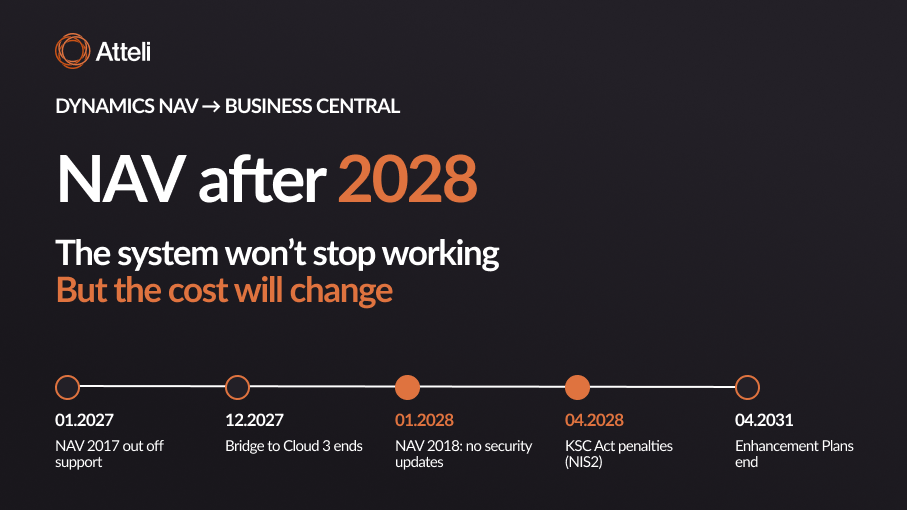
Key dates to keep in mind
- 11 January 2027 – end of support for NAV 2017.
- 31 December 2027: – end of the Bridge to Cloud 3 promotion, which gives 30% off Business Central online licences to companies that bought NAV before 1 September 2024 and have an active Enhancement Plan.
- 11 January 2028: – end of support for NAV 2018, the last version of the system. After this date there will be no more updates of any kind, including security patches.
- April 2028: – authorities can start imposing penalties under the amended Polish National Cybersecurity System Act (implementing NIS2), and essential entities should have completed their first audit.
- 30 April 2031 – end of Enhancement Plans. You won't be able to add users or renew your subscription.
Three costs that grow every year
1. Regulatory changes. KSeF, Poland’s National e-Invoicing System, shows this best. Companies running NAV had to bolt e-invoicing onto a system they will be replacing anyway, and from 1 January 2027 issuing an invoice outside KSeF can lead to penalties. The same will happen again with future changes to JPK (SAF-T) or e-invoice schemas. Money spent on this kind of customisation in NAV doesn’t carry over to Business Central, where the Polish localisation is kept up to date through extensions.
2. Security and management liability. No regulation prohibits using NAV. However, the amended Cybersecurity System Act, in force since 3 April 2026, requires companies within its scope to manage risk and updates. The GDPR also requires security measures that match the level of risk. The Polish Data Protection Authority (UODO) warns that using software no longer supported by its vendor may be treated as a breach of Article 32 of the GDPR. The cases the authority described concerned operating systems. For essential entities, penalties under the Cybersecurity System Act can reach EUR 10 million or 2% of revenue, and the head of the organisation is personally liable for up to 300% of their salary. An unpatched ERP system will therefore have to be documented in your risk analysis and defended during an audit. Customers are asking about it more and more, too: large retail chains and hospitals now send security questionnaires to their suppliers.
3. Technology and people. An older NAV version drags equally old versions of SQL Server and Windows Server along with it, and C/AL specialists are becoming harder to find. Every year of delay means higher maintenance costs and a longer road to a new system.
Consider a company that runs NAV 2018, falls under the Cybersecurity System Act and doesn’t plan to migrate until 2028. It will face the implementation project, its first audit and the lack of security patches all at the same time. This can be avoided if the decision is made earlier. (It’s worth confirming with a lawyer whether, and in what capacity, your company falls under the Act.)
Upgrade or reimplementation?
There are two paths. An upgrade moves your current system, including its history and customisations, to Business Central. It works well when your NAV version is relatively recent and there are only a few customisations that are well documented. A reimplementation means setting up Business Central from scratch around your current processes, carrying over master data, balances and settings. Your history can stay in NAV as read-only. This is often the better choice for older versions, when there are many undocumented customisations, or when the business has changed significantly since the original implementation.
The right path for you depends on a few specific factors: your NAV version, how many customisations are actually in use, your integrations, and how much history you need in the new system. It’s not a decision to make based on a generic price list.
The licence is the smallest part of the budget
Cost discussions usually start with licences, and this is where Bridge to Cloud 3 genuinely helps. But the discount covers licences only. Most of the budget typically goes on analysing and rewriting everything that has been added to NAV over the years, plus integrations, data migration, testing and training. We covered this in more detail in our article a licence is not an implementation
If you’re planning to move within the next two years, check whether you qualify for the promotion now. It ends a year before NAV 2018 support does.
How we start with clients
At Atteli, we don’t start with a quote. We start with an inventory. Together with your team, we establish:- your exact NAV version and Enhancement Plan status (this determines, among other things, eligibility for Bridge to Cloud 3),
- which customisations are actually used and which can safely be dropped,
- which systems are integrated with NAV, including those that access the database directly,
- what data history you need in the new system,
- the condition of your infrastructure and which risks need to be documented for NIS2 and GDPR.
Let's talk
We help companies move from NAV to Business Central, including in food and pharmaceutical manufacturing. You can see examples in our case studies, and our full range of services is described on our Business Central implementation page.
Sources
Microsoft: Dynamics NAV 2018 lifecycle, products reaching end of support in 2027, and in 2028, blog post on NAV migration options (28 July 2026)
NIS2 and the Cybersecurity System Act: Act of 23 January 2026, Journal of Laws 2026, item 252 (in Polish), gov.pl: amendment to the Cybersecurity System Act (in Polish)